
The CKYC Penalty No One Talks About: Duplicate UCICs and What They Cost Your NBFC
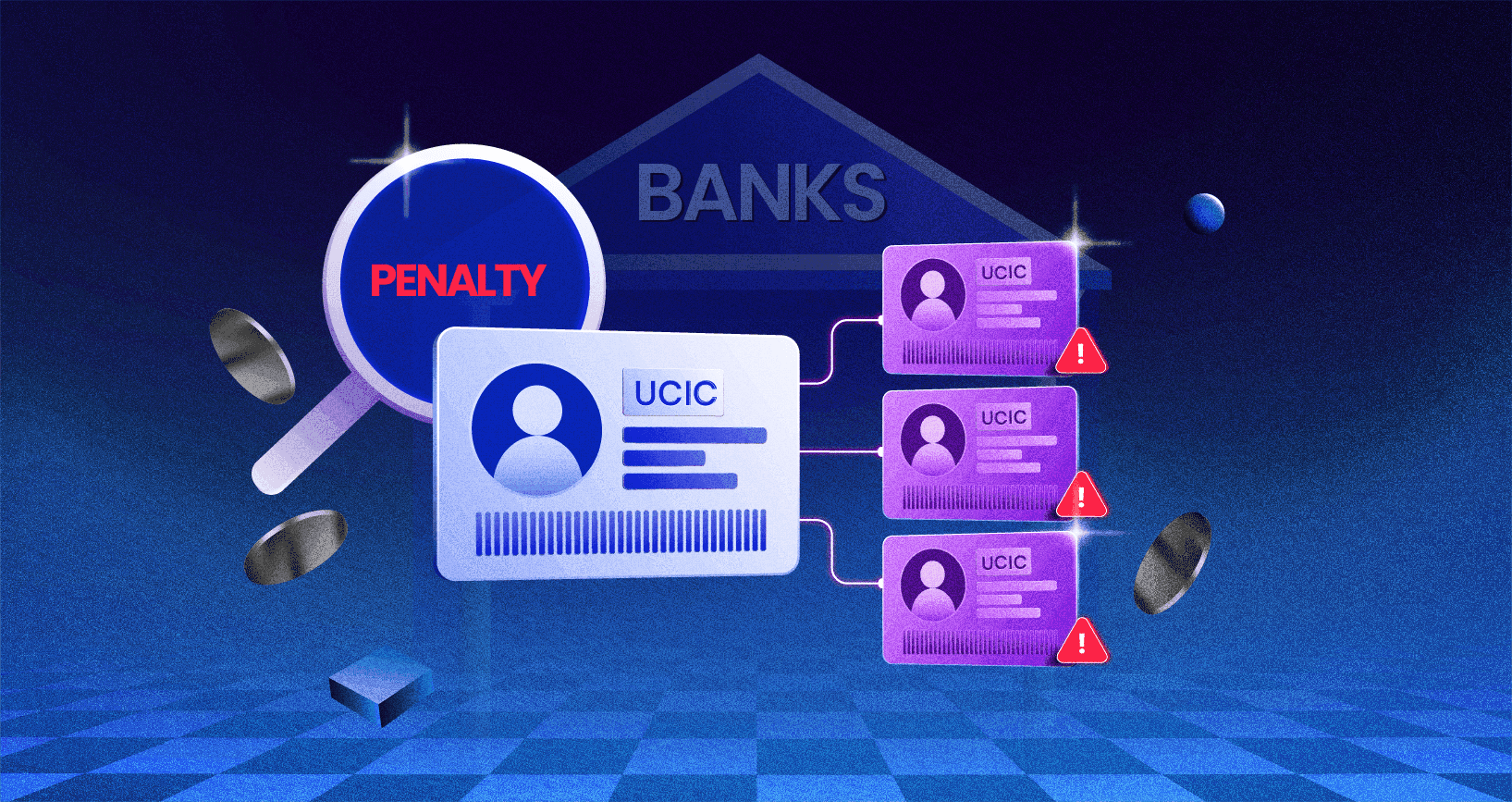
In FY 2024-25, the RBI imposed Rs 54.78 crore in penalties across 353 regulated entities. Of that, Rs 7.29 crore landed specifically on NBFCs and ARCs across 37 separate actions. KYC violations were among the top cited reasons.
Most compliance teams read these numbers and think about the obvious offences: not doing KYC at all, missing periodic updates, delegating verification to unqualified agents. Those are the headlines.
But there is a quieter violation sitting inside hundreds of NBFC systems right now. It does not announce itself. It does not generate a customer complaint. It will not show up in your internal audit unless someone knows exactly where to look.
It is the duplicate UCIC. And if your onboarding system is not connected correctly to your core banking or lending platform, you almost certainly have some.
What Is a UCIC, and Why Does the RBI Care So Much?
UCIC stands for Unique Customer Identification Code. It is a single identifier that a regulated entity assigns to each customer - one code, one person, across every product and account they hold with that institution.
The concept has been in the KYC Master Directions for years. But on November 6, 2024, the RBI sharpened its teeth. The amendment to Paragraph 10(f) of the KYC Master Direction, 2016. now explicitly mandates that all regulated entities apply the Customer Due Diligence (CDD) procedure at the UCIC level, not at the account level.
This is what that means in practice. If a customer already has a loan with your NBFC and wants to open a second credit line, you cannot run a fresh CDD on them as if they are a new customer. You must use their existing UCIC, retrieve their CKYC record, and build on the verification already done.
How Duplicate UCICs Actually Happen
This is the part that compliance reports rarely explain. A duplicate UCIC is not usually a human error. It is a systems architecture problem.
Here is the most common scenario. An NBFC's digital onboarding platform and its core banking or loan management system are two separate applications, integrated via an API or a batch file upload at end of day. A customer completes digital onboarding, gets a UCIC generated by the onboarding system. Later, the same customer applies for a second product. The loan management system does not query the onboarding platform in real time. It does not find the existing UCIC. It generates a new one.
Neither system threw an error. Nobody made a mistake. The process ran exactly as designed. And now you have one customer with two UCICs in your records.
The AK & Partners RBI Regulatory Penalty Report 2024-25, documents this pattern explicitly: multiple penalties in 2024 were issued specifically for allotting more than one Unique Customer Identification Code to the same customer due to poor integration between core banking systems and customer onboarding platforms. This is a systemic breach, not an occasional slip.
Root Cause | What Happens Technically | RBI View |
Onboarding platform not querying CBS in real time | New UCIC generated for returning customer | KYC Master Direction Paragraph 10(f) breach |
Batch sync delays between systems | Customer record not found; duplicate created | Fragmented CDD record; AML gap |
No deduplication logic at CKYC retrieval step | CKYCR not checked before fresh KYC collected | Paragraph 56(j) violation |
Manual entry in branch without system check | Agent creates new customer ID without lookup | Process failure, penalty risk |
What Duplicate UCICs Actually Cost Your NBFC
Most compliance officers think of a UCIC error as a data quality issue. The RBI treats it as a structural compliance failure. The costs are different.
The Direct Penalty
The RBI Annual Report for FY 2025, released on May 30, 2025, confirmed Rs 7.29 crore in penalties on 37 NBFCs and ARCs for the year. KYC directions violations were among the stated grounds for enforcement. The highest single penalty imposed across all entities in FY25 was Rs 5.93 crore, on a cooperative bank for governance failures. NBFC penalties ranged from lakhs to crores depending on the scale of the breach.
The Hidden Operational Cost
Fixing a duplicate UCIC after the fact is expensive. You need to identify all duplicate records across your customer base. Merge or deactivate one UCIC per customer pair. Reconcile the associated loan accounts, KYC documents, and transaction history. Update the CKYC Registry record to reflect the correct single identifier. And document the remediation for the regulator's review.
For a mid-size NBFC with a customer base in the hundreds of thousands, this is not a weekend project. It is a 2-4 month remediation programme with legal, tech, and ops teams involved. The direct penalty number is the smaller part of the cost.
The AML Blind Spot
This is the cost nobody calculates. When one customer has two UCICs, your transaction monitoring system sees two customers. If Customer A is flagged as medium risk on one UCIC, their transactions on the second UCIC are being assessed against a fresh, low-risk profile. The AML alert that should fire does not fire. The suspicious transaction goes unreported. That is a PMLA exposure sitting quietly inside your data.
The November 2024 Amendment Made This Urgent
Before the November 6, 2024 amendment, UCIC management was a compliance good practice. After it, it is a specific regulatory obligation with an explicit paragraph reference in the Master Direction.
Paragraph 10(f) now reads: Regulated entities shall apply the CDD procedure at the UCIC level. If an existing KYC-compliant customer desires to open another account or avail any other product or service from the same RE, there shall be no need for a fresh CDD exercise as far as identification of the customer is concerned (as reported by Business Standard, November 6, 2024
The intent is clear. The RBI wants one unified identity record per customer, not a fresh verification every time they interact with your institution. But that intent creates an obligation: you must have a system that can find an existing UCIC before creating a new one. If your system cannot do that reliably, you will keep generating duplicates.
And when the RBI inspection finds those duplicates, the November 2024 amendment is now the paragraph they will cite.
The CKYC Registry Connection
There is a second layer to this problem that most NBFCs have not addressed. Paragraph 56(j) of the Master Direction, amended on the same date, restricts regulated entities from asking for fresh KYC documents when a CKYC record already exists in the Central KYC Registry.
The sequence the RBI now requires is: check the CKYC Registry first, retrieve the customer's existing 14-digit KYC Identifier, use that identifier to pull their verified record, and build the UCIC on top of that. If you collect fresh documents without checking the Registry, that is a Paragraph 56(j) breach. If you then generate a UCIC without checking your existing records, you compound the problem with a Paragraph 10(f) breach. Two violations from one poorly designed workflow.
A Self-Audit Checklist for Compliance Officers
Before your next inspection, answer these questions about your current systems. If any answer is No or I am not sure, you have a UCIC integrity gap to close.
Does your onboarding platform query your core banking or lending system in real time before generating a new UCIC?

Does your onboarding flow check the CKYC Registry (CKYCR) before collecting fresh documents from any customer?
Do you have a deduplication process that matches incoming customer records against existing UCICs using PAN, Aadhaar, date of birth, or mobile number?
Can your compliance team run a database query today to identify customers with more than one UCIC in your system?
When a customer opens a second product or account, does your system automatically link it to their existing UCIC without creating a new one?
Is your AML transaction monitoring applied at the UCIC level, consolidating activity across all products for one customer?
Is your CKYC upload workflow triggered by the same UCIC, ensuring the Registry record and your internal record are aligned?
What Fixing This Actually Looks Like
The fix is not complicated to understand. It is complicated to implement if your current architecture was not designed for it.
What you need is a single lookup at the beginning of every customer journey. Before any UCIC is generated, your system must check three things in sequence: Does a UCIC for this person already exist in your internal records? Does a CKYC record for this person exist in the CKYC Registry? If yes to either, retrieve that record and use it. If no to both, then and only then create a new UCIC and initiate fresh KYC collection.
For NBFCs building this in-house, that is a significant engineering project. It requires real-time API integration with CKYCR, a deduplication engine that matches on multiple identity parameters, and a data governance layer that prevents parallel UCIC creation. Every time the RBI updates the Master Direction, the engineering team revisits the implementation.
AIFISE’s CKYC Automation Solution handles the CKYCR lookup, UCIC deduplication, and compliance workflow natively. The platform checks the Registry first, retrieves existing records, and prevents duplicate UCIC generation at the architecture level - not as a patch, but as the designed default. The November 2024 amendment was absorbed as a platform update, not as an engineering project for the NBFC.
For fintechs and NBFCs evaluating their options, the question to ask any vendor is direct: does your solution perform the CKYCR lookup before UCIC generation, or after? If the answer is after, or if it is handled by a separate module, the gap is still there.
The Opinion Worth Stating Directly
The duplicate UCIC problem does not get the attention it deserves because it is invisible. No customer complains. No transaction fails. The NBFC operates normally - until it does not.
Penalty data from FY25 shows the RBI is not waiting for fraud to occur. It is penalising the conditions that allow fraud to be undetected. A fragmented customer identity record is exactly that kind of condition.
Compliance officers who are still treating UCIC management as a data quality task are one inspection cycle behind. The November 6, 2024 amendment made it a regulatory obligation with a specific paragraph reference. That changes the conversation from should we fix this to what is our timeline for fixing this.
If the answer to that question is uncertain, the checklist above is where to start. Book a structured workflow review with AIFISE and get a clear picture of where your UCIC integrity stands before your next RBI inspection does it for you.

Frequently Asked Questions
Q: What is a UCIC and who needs one?
A: A Unique Customer Identification Code (UCIC) is a single identifier assigned by a regulated entity to each customer. All RBI-regulated entities - including NBFCs, banks, and HFCs - must assign and maintain UCICs per the KYC Master Direction. As of November 6, 2024, the CDD procedure must be applied at this UCIC level, not at the account level.
Q: A duplicate UCIC a penalised offence?
A: Yes. The AK & Partners RBI Regulatory Penalty Report 2024 documents multiple penalties issued specifically for allotting more than one UCIC to the same customer. The RBI Annual Report FY25 confirms Rs 7.29 crore in penalties on 37 NBFCs/ARCs, with KYC direction violations among the stated grounds.
Q: What does the November 2024 RBI amendment change about UCICs?
A: Paragraph 10(f) of the KYC Master Direction was amended on November 6, 2024, to explicitly mandate CDD at the UCIC level. If an existing KYC-compliant customer wants a new product or account at the same institution, no fresh CDD is required - the existing UCIC must be used. The amendment was effective immediately from November 6, 2024.
Q: How does CKYCR connect to the UCIC problem?
A: Paragraph 56(j) of the same November 2024 amendment restricts regulated entities from collecting fresh KYC documents if the customer already has a CKYC record. The correct flow is: check CKYCR first, retrieve the 14-digit KYC Identifier, build on the existing verified record. Skipping this step and then generating a new UCIC creates two violations simultaneously.
Q: How do I check if my NBFC has duplicate UCICs?
A: Run a deduplication query across your customer database matching on PAN, Aadhaar hash, date of birth, and mobile number. Any customer appearing more than once under different UCICs is a duplicate. Most mid-size NBFCs discover duplicate rates of 1-5% when they run this exercise for the first time.
Q: Can AIFISE fix existing duplicate UCICs?
A: AIFISE's CKYC Automation solution prevents new duplicate UCICs from being generated through real-time CKYCR lookup and deduplication logic. For remediation of existing duplicates in your database, a structured data audit and merge process is required - AIFISE's implementation team supports this as part of onboarding.
Q: What is the penalty for KYC non-compliance for NBFCs?
A: Under the Banking Regulation Act and RBI's enforcement powers, penalties can range from lakhs to crores per violation depending on scale and severity. In FY25, NBFCs and ARCs paid Rs 7.29 crore across 37 penalties. In severe cases - as seen with Paytm Payments Bank in January 2024 - the RBI can also restrict new customer onboarding entirely.
Try it yourself
Start your journey with AIFISE today!
Start your journey today and unlock the full potential of secure, efficient, and innovative solutions tailored to your business needs.